Your tests passed. Is the business protected?
Behaviorproof turns test results into one honest answer per business behavior: how well it is covered, how far to trust that, and what to fix next. Derived from evidence, never typed into a spreadsheet.
Works with the tests you already have. Post JUnit or Playwright results from any pipeline, or import a catalog from CSV, and the intelligence builds itself.
Portfolio posture
Action neededCoverage
71%target 80
Critical unprotected
3of 27
Start with a house, not a spreadsheet
A test-case tool is an inventory of smoke detectors.
Imagine your product is a house, and bugs are fires. What you actually care about is one sentence: if a fire starts in any room, will we know before it spreads?
An inventory can tell you that you own 24 detectors and 22 of them showed a green light last time someone checked. That sounds like safety. It is a list of equipment. It can never answer room questions, because it starts from detectors. To know whether the nursery is protected, the list of rooms has to come first, and the detectors have to be attached to rooms, not filed in a drawer.
Behaviorproof is the list of rooms. A behavior is one room: one thing the business relies on that must keep working. Tests, in all their forms, are the detectors attached to it.
1,200 passed
Detectors that stayed quiet. Says nothing about the rooms without one.
85% lines
Floor area walked through. Says nothing about which rooms matter.
The inventory cannot answer
- Which rooms have a detector? Is there one in the nursery?
- Are the batteries fresh, or five years old?
- Which one beeps randomly, so everyone has learned to ignore it?
- A room nobody fitted is a row that was never created. Invisible when it matters most.
The list of rooms answers
- Every room exists first, rated by what burns if it goes, even with zero detectors.
- Which rooms have a working detector, and how fresh its battery is.
- The beeping one counts against you until someone owns it or fixes it.
- Critical rooms protected: 41 of 48. Seven exposed. Here they are.
Rooms are behaviors. Detectors are tests, manual checks and exploratory sessions, attached as evidence. Battery age is how old the evidence is. The beeping detector is a flaky suite. The number on the inventory describes effort. The number on the list of rooms describes protection.
What you get
One model, the behavior, and everything else derived from the evidence behind it. Here is what that changes on a Monday morning.
A ranked list of what to fix next
Exposure weighs risk against real coverage, so one untested critical flow outranks a hundred low-risk gaps.
- Most exposed, failing, stale and unprotected, each a list you can work
- Every list opens the exact behaviors, ready to assign or record
- Gaps named by what is missing: no automation, one environment, evidence gone stale
One honest number, with a target to hold it to
Coverage and confidence are derived from evidence: what ran, how recently, on which environments, how flaky. Nothing is typed in, so nothing can be gamed.
- Portfolio and per-project targets, red or green against the same ruler everywhere
- Confidence explains itself: the reasons and the improvements that would raise it
- Accepted risk is recorded as a waiver with an owner and an expiry, not hidden
Proof you can hand to anyone
When someone asks whether a release is protected, answer with a document rather than a feeling.
- A posture PDF for any scope and date window: what ran, what failed, what never ran
- Nightly snapshots, so trends show what was true on each day, not a reconstruction
- An audit log of every change and who made it
Three moves, and nothing to maintain
No score to update, no spreadsheet to reconcile, no test to rewrite. Name the behavior, let the evidence arrive, read the result.
Name the behaviors that matter
Model your product as behaviors in a project and component tree, with a risk rating each. Import an existing catalog from CSV, or start with ten.
Keep your tests where they are
Post JUnit XML or Playwright JSON from any pipeline. A test maps to a behavior by id in its title or tags. Record manual and exploratory runs in a click.
Read the answer, every morning
Coverage, confidence, gaps and exposure are derived the moment evidence lands, then snapshotted nightly. The board tells you what changed and what to do.
A board for every question
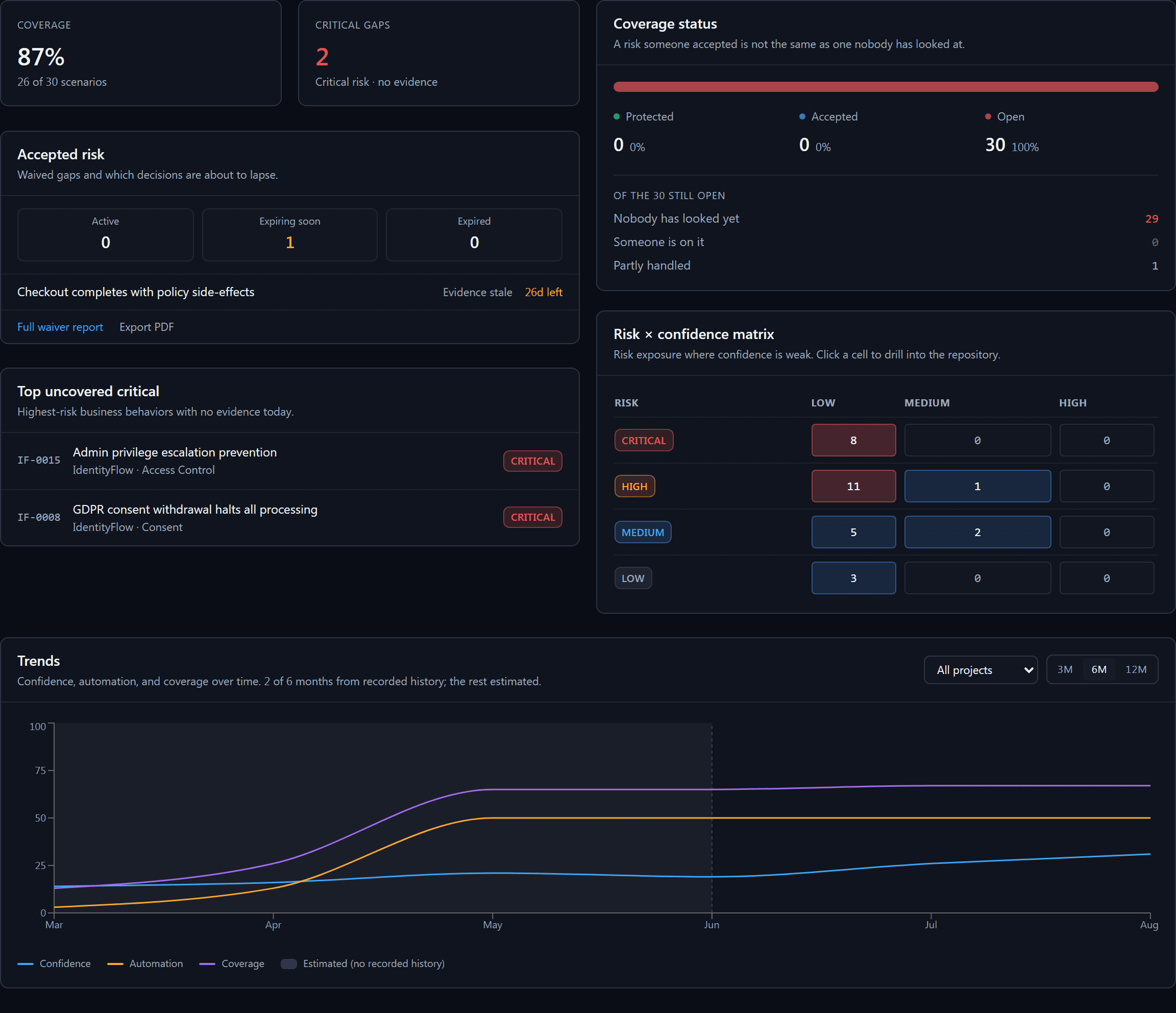
The same derived data answers different questions for different people. Apply a preset in one click, then add, remove, reorder and scope widgets until the board reads the way your team does. Every board is shareable by URL, and every number on it opens the behaviors behind it.
Executive
Are we protected against the targets we set, and where is the risk?
Product
Which behaviors in this release have no evidence behind them?
QA lead
What runs, what fails, who owns it, and what needs automating next?
Developer
What broke, what got flaky, and what am I expected to fix?
Are we protected, what did we accept, and which way is it moving?
Live product, seeded demo workspace. Every number shown is derived from behavior evidence.
Find out what your green suite is not telling you.
Import a CSV or model ten behaviors, post one CI run, and read the first answer the same day.